Psidium-guava, Guava, Jambu biji

|

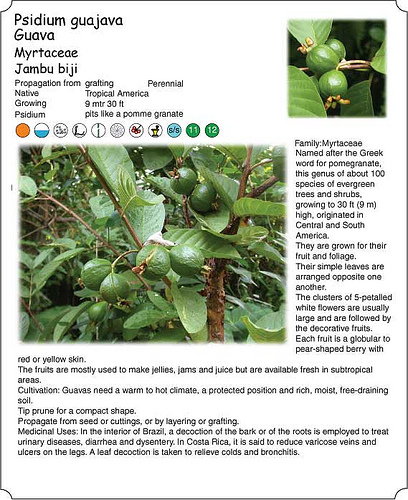
Medicinal Uses: In the interior of Brazil, a decoction of the bark or of the roots is employed to treat urinary diseases, diarrhea and dysentery. In Costa Rica, it is said to reduce varicose veins and ulcers on the legs. A leaf decoction is taken to relieve colds and bronchitis.

Guava Medicinal Benefits

|

Since the early fifties keen interest has been elicited about Guava especially the leaves. Efforts were made to identify the ingredients which are effective in various medicinal properties exhibited by Guava leaves. Guava leaves are used in various native medicines used. guava leaves contain ingredients which have a role to play in various ailments such as cancer, Infections, inflammation, and pain. Essential oil of guava leaves have been particularly effective in improving the prognosis of cancer and other immunological diseases.

Guava leaves have been used in treating diarrhea and the bark is used for its microbicidal and astringent action. The leaves and bark is also used in dysentry and diabetes. Guava originated in Peru and archaeological excavations have revealed that it was cultivated by the indigenous people. The tree is wide spread in the rain forests and therefore has a long history of its use by the natives of these rain forests and they are still used in modern times.

A decoction of the leaves and the bark are used by the Tikuna natives for dysentry. The treatment is so effective that it is being used by the inhabitants of the cities also. The Amazon Indians also use the leaves extract for diarrhea and as a gargle for sore throat, emesis, digestive ailments, and menstrual disorders. The leaves are also used as a mouth freshener and relief from tooth aches. The leaves extract is also used as a douche for candidiasis and for the tightening of the vaginal walls especially after child birth. Leaves are crushed and applied on wounds and bruises. Flowers are crushed and the extract is used as eye drops to alleviate the pain and burning during conjunctivitis or sun strain. The benefits of Guava leaves have also been mentioned in the old Dutch pharmacopia. The fruit was taken to other parts of the world by the Dutch and other explorers. In modern days guava's are found in most parts of the world.

Guava – Health Benefits of Guava

|
Guava is a tropical fruit that is like the shape of pear, with green rind and pinkish or white flesh and small seeds. Some people say Guava is better than orange because guava contain more Vitamin C than citrus fruits (the edible rind contains a lot of it) and it contains appreciable amounts of Vitamin A as well. They are also a good source of iron and pectin, an enzyme used in making jams as well as promoting digestion.

Once they’re ripe, eat them quickly because they’re only at their peak for about two days. The guava leaf extract is also effective in treating gastrointestinal problems as it is rich in quercetin and other flavonoids. A drug used for the treatment of diarrhoea has been developed using guava leaves for this very reason. The bark extract is also supposed to protect the heart and improve its functionality and has been recently used to treat irregular heartbeats in South America. Guava leaves are also supposed to be good for weight loss.

The benefits of guava include controlling blood pressure, lowering cholestrol, battling diabetes, combating cancer and protecting prostrate!

Diarrhea & Dysentery: Guava is very rich in astringents (compounds those make your gums feel tighter and fresh after you chew guava leaves or eat a raw guava or use some toothpaste) which binds up loose bowels in diarrhea. These astringents are alkaline in nature and have disinfectant and anti-bacterial properties, thus help cure dysentery by inhibiting microbial growth and removing extra mucus from the intestines. Further, other nutrients in guava, such as vitamin-C, Carotenoids and potassium strengthens and tones up the digestive system and disinfect it. Guava is also beneficial in gastroenteritis due to reasons stated above.

High amounts of Vitamin C compared to other fruits. The flesh usually provides 230 mg per 100 gram (3.5 oz) Vitamin C. However, the level varies from 10 to 410 mg per 100 gram depending upon the variety. This can be compared to the recommended daily allowance which is only 60 mg of Vitamin C per person per day.

Pink Guava

|

Pink or Pink Guava Guava is the best source of nutrition for good health and a number of vitamins and minerals including vitamin C, vitamin A, calcium, potassium and folate. It is a good source of fiber for human body systems, and to help prevent gastrointestinal cancers and lowers cholesterol levels in the blood. Studies by the USDA lists as one of the best Pink Guava world and the highest content of Vitamin C than others.

According to the study, guava can reduce cholesterol levels in the body of 18.8%. Recommended 400gm guava take a day, as the promoters to manage weight.

Take advantage of your health by drinking Pink Guava Juice. This practice can be overcome or reduce health problems or illnesses following:

Guava Juice

|
Popularly known as the superfruit, the apple shaped delicacy-- Guava is a tropical fruit. Cultivated in the shades of yellow and green, it offers a flavorful tasty burst that reminds of pears and strawberries. The tasty fruit juice, guava nectar is also used in a number of tropically themed alcoholic drinks, since the sweetness pairs well with alcohol. It may also be mixed with carbonated water to create a freshing cooling drink, in the production or sorbet and ice cream.

Guava juice is known to be a great thirst quencher as well as an extremely rich source of vitamin C and iron. It is believed that this tropical fruit was originally cultivated in the current day Mexico or Central America. Today the highly nutritious guava juice is enjoyed around the world. The major producers of guava in the world are India, Brazil, and Mexico.

Origin
The tropical Guava is the native of South America. When the early Spanish explorers moved to this region in the 1500s. they found Strawberry Guava, ‘Acca sellowiana O.,' growing as a tree. They adopted the Mesoamerican name for it when describing it to others and also started growing it in shrubs and small trees. History records that Seminole Indians were growing guava trees in Northern Florida in 1816.

"Guavaween" is a traditional central Florida event and fund raiser that is held every year to celebrate the advent of the guava corresponding to parades and festivals that are scheduled near Halloween at holidays Ybor City, Florida, an outskirt of Tampa, Florida. This "Guavaween" event is celebrated during the last of October each year.

Benefits of The Multi-Purpose Healer
Guava juice is an extremely rich blend of Vitamin C (the skin of guava contains more than 5 times Vit. C than that of an orange), Vitamin A and B, Calcium, Nicotinic Acid, Phosphorus, Potassium, Iron, Folic Acid and Fibers. Owing to such an amazingly benefecial profile, the juice is advantageous for:
Raw Guava

|
Raw guavas are eaten out-of-hand, but are preferred seeded and served sliced as dessert or in salads. More commonly, the fruit is cooked and cooking eliminates the strong odor. A standard dessert throughout Latin America and the Spanish-speaking islands of the West Indies is stewed guava shells (cascos de guayaba), that is, guava halves with the central seed pulp removed, strained and added to the shells while cooking to enrich the syrup. The canned product is widely sold and the shells can also be quick-frozen. They are often served with cream cheese. Sometimes guavas are canned whole or cut in half without seed removal.

Bars of thick, rich guava paste and guava cheese are staple sweets, and guava jelly is almost universally marketed. Guava juice, made by boiling sliced, unseeded guavas and straining, is much used in Hawaii in punch and ice cream sodas. A clear guava juice with all the ascorbic acid and other properties undamaged by excessive heat, is made in South Africa by trimming and mincing guavas, mixing with a natural fungal enzyme (now available under various trade names), letting stand for 18 hours at 120º to 130º F (49º-54º C) and filtering. It is made into syrup for use on waffles, ice cream, puddings and in milkshakes. Guava juice and nectar are among the numerous popular canned or bottled fruit beverages of the Caribbean area. After washing and trimming of the floral remnants, whole guavas in syrup or merely sprinkled with sugar can be put into plastic bags and quick-frozen.

There are innumerable recipes for utilizing guavas in pies, cakes, puddings, sauce, ice cream, jam, butter, marmalade, chutney, relish, catsup, and other products. In India, discoloration in canned guavas has been overcome by adding 0.06% citric acid and 0.125% ascorbic acid to the syrup. For pink sherbet, French researchers recommend 2 parts of the cultivar 'Acid Speer' and 6 parts 'Stone'. For white or pale-yellow sherbet, 2 parts 'Supreme' and 4 parts 'Large White'. In South Africa, a baby-food manufacturer markets a guava-tapioca product, and a guava extract prepared from small and overripe fruits is used as an ascorbic-acid enrichment for soft drinks and various foods.

Guava goodness

|
LOOKING for a fruit high in vitamin C? Guava may well be your answer.

It has been reported that one large guava (820g) contains 1,221mg of vitamin C. The vitamin C is found in the whole fruit, not just in the skin. Researchers have found comparatively higher levels of vitamin C in the skin than in the flesh and the lowest amount was found in the central pulp of the seeded varieties. Vitamin C content declines if the fruit is overripe.

Vitamin C is one of the important nutrients in fruits. We are encouraged to include at least 200g of fresh fruit in our diet every day. Vitamin C functions as an antioxidant in the body. It is critical for good immune functions and maintaining good health.
In view of changing lifestyles, the amount of vitamin C included in our diet has been revised to higher levels. Depending on age group, the US National Academy of Sciences recommends daily adequate intake levels of vitamin C to be around 100mg and sets a tolerable upper intake level of 2,000mg (2g) for adults 19 years and above.

The Nutrient Composition of Malaysian Foods showed that 100g of guava provide 152mg of vitamin C; papaya gives 71mg and pear, 6.1mg. A 100g slice of guava has sufficient vitamin C to meet our daily needs.

For the heart, colon and more

Quercetin is another highly sought after nutrient in guava. Many medicinal plants owe much of their activities to their high quercetin content.

Quercetin is also the flavonoid that is responsible for the strong antioxidant activities in fruits and vegetables, especially apple, red grape and onion.

Guava

|

Guavas are plants in the myrtle family (Myrtaceae) genus Psidium (meaning "pomegranate" in Latin), which contains about 100 species of tropical shrubs and small trees. They are native to Mexico, Central America, and northern South America. Guavas are now cultivated and naturalized throughout the tropics and subtropics in Southeast Asia, Hawaii, the Caribbean, Florida and Africa.

The term "guava" appears to derive from Arawak guayabo "guava tree", via the Spanish guayaba. It has been adapted in many European languages: guava (Romanian, Swedish, Danish and Norwegian, also Greek Γκουάβα and Russian Гуава), Guave (Dutch and German), goyave (French), gujawa (Polish), goiaba (Portuguese).

Outside of Europe, the Arabic jwafa, the Japanese guaba (グアバ), the Tamil "koiyaa" (கொய்யா), the Tongan kuava and probably also the Tagalog bayabas are ultimately derived from the Arawak term.